
North Star: A Tribute to Our Founder, Frank Gehry
By Malissa Shriver,
Turnaround Arts California Co-founder and Board Chair
Frank Gehry taught students at our nation’s most prestigious private universities, and at California’s most under resourced public schools, that their signatures were invaluable. He had them compare and contrast theirs with classmates, it was a simple but profound lesson in personal expression, in the importance of both knowing oneself, and holding onto that knowing throughout one’s life. Frank’s life was his work, his art making was vivifying, he wanted more years, more time to create, to apply the signature he had refined for nearly 97 years.
Frank Gehry was a true master. He aspired to master the craft of architecture, for him it was a fine art, as it was for the Romans and the Greeks, not the bloodless work of engineers and applied math. He apprenticed himself to the great artists, ancient and modern. Frank invented an architecture born of his signature, he dreamt primordial designs that he translated technically. He drew the humane world he desired, and inspired others to do so as well. He wanted to be understood, to be felt, and he expressed himself through the disciplined mastery of his craft, but perhaps more profoundly through the painstaking study of himself. His life quest was a dynamic and visceral continuation and celebration of what he found moving in art, sculpture, and classical music. He designed fantastic yet intimate cathedrals for the worship of artistic disciplines, volumes to hold sacred aesthetic time, magnificent vessels for personal emotional experience. A master inspires devotion, and this is why people worldwide make pilgrimages to experience his creations, to be entranced by his artistry, to be uplifted by the ethereal signature of Frank Gehry.
Frank’s work was about feelings. He knew that art had the power to transform, to unite, to engender empathy. Frank’s office has a large picture of the bronze Charioteer of Delphi from 500 B.C. He saw it initially in Greece with Ed Moses, on their own artistic pilgrimage. “I looked at it and looked at it, and I started crying. The thought that somebody 2,500 years ago working in an inert material could transmit feelings across the ages to somebody, that’s my North Star. If I can do that, if I can make a building that makes people feel something and transmit feeling through inert materials, then that’s my job. And that’s hard to talk about.” Frank Gehry said in stone, and titanium, and glass, what was and is beyond words. His creativity surmounted the quotidian constraints of public commissions, his passionate apprenticeship transcended even his own expectations.
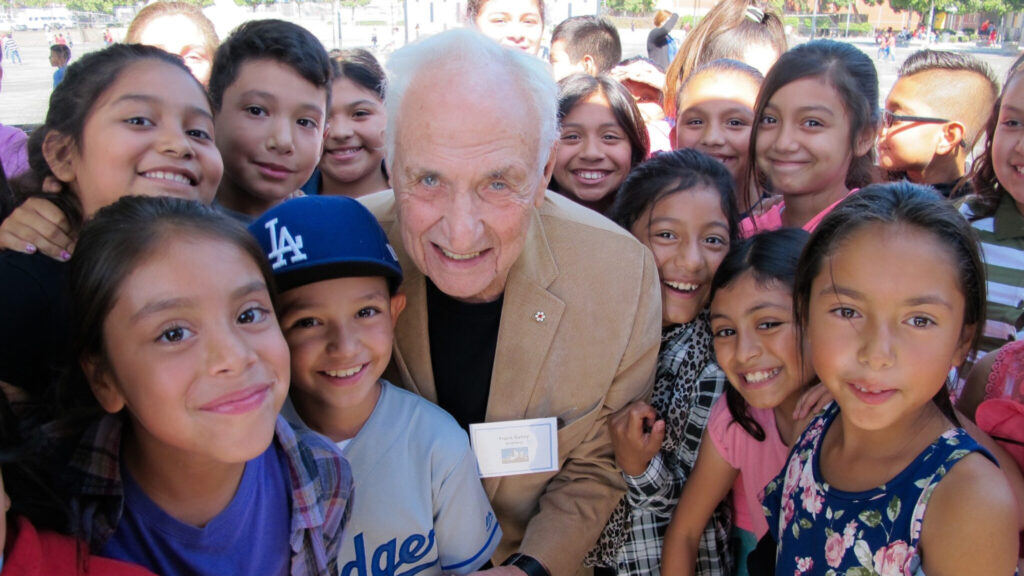
Frank was esteemed, but above all he fulfilled the goal he had set for himself, and like the unknown sculptor of the Charioteer, his work emanated emotion through the inert materials of his craft. He enlivened concrete, illuminated chain link, made cardboard fluid. Frank’s creative process was a kind of learned reverence, he exemplified an understanding of the mind’s role in guiding the self towards the apex of its spiritual journey, the heart towards the soul’s ultimate purpose, navigating obstacles with unwavering loyalty to one’s true self, fearless and steadfast. Frank has finally completed his physical journey, and we are left with his wondrous signature, his eternal essence communicated in form. I believe this is why he supported arts education, because he knew that without his own, he might not have discovered his singular soul’s purpose. He wanted to show you everything you could become. He wanted more than anything to be known, deeply seen, and he wanted that for all young people. Venturing into the unknown of each artistic project enabled Frank to rediscover a pure faith in himself. This was a facet of his greatness, the great master founding and funding Turnaround Arts California, an arts education non profit out of his offices. Not glamorous, but glorious was his intention to serve others, creative opportunities for children who benefit the most, and too often receive the least. Like Einstein, Frank believed that imagination was paramount to knowledge, the mind bound by time and space, while imagination, like the spirit, encircled the world. He set his sights on his own North Star, and his talent encircled the world.

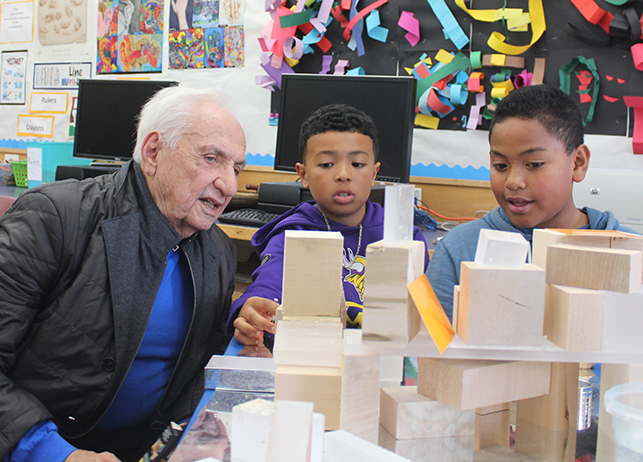
It is inescapable that people have most focused on Frank’s sculptural, curvilinear forms, his luminous exterior surfaces, and yet what I find most profound about his architecture is how he enchanted and enlivened space, he drew shapes that contain and express something sacred, eternal, venues for values he held dear. He cared about people. I witnessed him change children’s lives through play, sensitive listening, and art making. Frank’s practice was like a religion, it communicated “models of and models for” living. His office houses thousands of prototypes, models of the possible, the never before seen, models made over and over again, artifacts of the rigorous, iterative, collaborative processing that culminates in mastery.
Gustav Mahler, revered by Frank, said, “all that is not perfect down to the smallest detail is doomed to perish.” Frank’s perfectionism was fastidious, fine tuning every angle, each undulating curve, but it was also intentionally emotional, how relationships might be enhanced within, the felt communal experiences for the inhabitants of his worlds. He astonished and connected us in awe. These human details are his nonperishables. His structures are dazzling, humanizing, moving, as he was moved when confronting the charioteer, the pulse of life emanating like consciousness from a work of art, an unknown ancient sculptor communicating, inspiring a modern master, this continuum of artistic representation that brings us to tears across time. Mahler once described writing a symphony as “building a world.” Frank’s world was composed as a symphony, his “orchestras” united Palestinians and Israelis in Berlin, marginalized students with Maestros, modern musicians with compositions across centuries and genres, he was a deconstructionist jazz master of liminal space.
Our architectural charioteer was a boy sorcerer from Canada, a student and teacher of wisdom, a shooting star from the far North, he was a gift for our pale and profane world of careless creation and disdain. He was a magician, a linguist who reinvented and built his own emotional vernacular. A rabbi once told Frank’s parents that their son had “golden hands.” Those hands drew beauty across our planet, and they worked their magic for close to a century. His hands held ours, in creating art that linked us together, his walls did not divide, they invited you in. Like Matisse in old age, drawing from his bed, Frank’s protean creativity, his legacy of mastery is everlasting. He blessed us with his prolific body of work, an enduring inheritance of towering temples in space and time, for us to be transformed and inspired by, and above all, to find and feel our own best selves within.